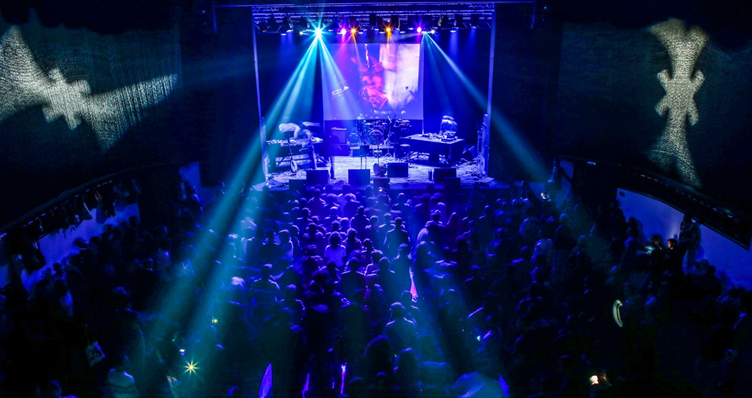
The floor beneath his seat rumbled as a thousand projected suns rose across the curved horizon. Chet Udell sat in the heart of the Las Vegas Sphere, surrounded by a seamless dome of ultra-high-definition screens. It felt like floating inside a planet. No visible edges, just light and sound in every direction. A gust of air struck his face in sync with a visual explosion onscreen, followed by a bass drop that pulsed through the haptic seat. The audience gasped, not in applause but in awe. No one was filming. They were too busy holding on.
This was more than a concert, it was a sensory takeover. But as Chet gripped the armrest, blinking in the artificial sunrise, he found himself thinking not just about the show, but about what it took to build an experience like this.
In an era of virtual concerts, hyper-real visuals, and AI-generated soundscapes, three creators make a compelling case for physical presence. “Humans want to rub shoulders,” one says. “We don’t just want to watch, we want to feel like we’re part of it.”
Music venues are evolving. Some quietly, others with dazzling spectacle. While many still center on sound, others are being reimagined as fully immersive environments, where audiences interact with light, motion, and even scent. Donatellia sees these trends unfolding from the inside. She helps design performances that turn passive viewers into engaged participants and explains that tools like synchronized light-up bracelets or aromatic fog pull audiences deeper into the moment. The aim, she explains, is to lower the boundary between performer and crowd, to make the audience feel like they belong inside the show.
Engineering professor, performer, and instrument designer Dr. Chet Udell offers another vantage point, having experienced the cutting edge of concert immersion at the Las Vegas Sphere. There, haptic seats, air bursts, and panoramic visuals create a sensory overload unlike anything found in traditional venues. For Chet, it’s a glimpse of the future, but also a reminder of how unequal access can be when such experiences are tied to wealth and exclusivity. While Donatellia points to a growing cultural divide, some communities demanding scale and spectacle, others seeking intimacy and authenticity, Chet underscores the importance of physical presence and human connection. Both suggest that the future of live performance will not be a single destination, but a branching path: one side built on escapism, the other rooted in togetherness.
Transforming the Good Ol’ Concert Hall
Donatellia Austin is the Lead Events Technician at the Patricia Valian Reser Center for the Creative Arts (PRAx) at Oregon State University. We spoke on a partly cloudy Monday afternoon, as preparations were underway for an event. Donatellia oversees PRAx’s lighting systems and networking equipment. She studied Art and 3D Sculpture, and one of her standout projects was the set of pyramids that lit up and played the tones of Tibetan singing bowls. An array of pyramids stretched out in a large, 10-foot-wide display. A glowing pyramid rests in the center. When an audience member touches it, the chiming of Tibetan singing bowls rings out. Starting from the center, the array of pyramids glows, expanding outward, then inward, just like the human breath during meditation.
Her interest in interactive design continued at PRAx, where she helped produce Dance^2, a performance that responded to audience input via their phones. With the audience seated close to the performers, the event felt unusually intimate. Music venues weren’t always open to the public. Concert halls in the 18th century started to be designed for orchestras and performances that are catered toward the public. Venues in the 19th and 20th century started to be a sign of cultural pride and innovation, like Carnegie Hall. Gas and electric lighting and comfortable seating started to become mainstays in the live music experience (Herr, Christopher, and Gary Siebein). Traditional venues became a cultural landmark, something that helped define the cultures surrounding them.
When asked how multisensory technology might transform traditional music spaces, Donatellia pointed to the light-up bracelets used at Taylor Swift concerts. These bracelets, triggered by radio-frequency signals, turn the crowd into an extension of the performance, allowing lighting designers to include the audience in a synchronized visual display. She also mentioned scented fog for fog machines, like Froggy’s Fog oils, which can fill a venue with aromas ranging from peppermint to popcorn. Though rarely used, they hint at how performances might one day appeal to all the senses.
Chet, a performer and designer of experimental instruments, offered a different perspective after attending the Sphere in Las Vegas. The venue featured a vast dome of ultra-high-definition screens, haptic seats, air blasts timed with on-screen action, and precise spatialized sound using ultrasonic speaker arrays. The result was a completely immersive concert experience. Chet called it “the future of live performance,” but he was quick to point out that access to this kind of spectacle is limited. Tickets are expensive, and the venue is in a city that thrives on massive daily cash flow. According to him, venues like the Sphere require so much infrastructure and expertise that they can only survive in places like Las Vegas or Dubai.

Who Benefits from all this Fancy Tech?
Donatellia acknowledged similar concerns, explaining that high-end technologies often emerge in elite settings but eventually become more widely available. She argued that commercialization, while sometimes viewed negatively, has helped make beginner lighting and stage tech more accessible to new artists and technicians.
Both interviewees emphasized the importance of cultural context. Donatellia has worked on high-tech performances, but she also designs minimal setups for intimate shows, like Garrick Ohlsson’s piano recital at PRAx. Some genres thrive on spectacle, such as EDM and Vocaloid concerts, while others like folk, jazz, or classical, often benefit from simplicity and closeness. Allie mentioned that one factor of this closeness is improvisation, and that one concert is never the musically the same as another. Chet expanded on this idea, noting that different technologies resonate with different performance cultures. For example, while AR might add new layers to an electronic show, it would feel out of place in a traditional chamber music setting. Many smaller, more intimate venues can become icons to the community that surrounds them. The Click Club in Australia, and the volunteerism surrounding it, show that venues are cultural products and help create a sense of belonging and identity (Roberts). The economic models that support venues may shift toward non-profit or alternative ownership methods to ensure that local venues can stay open.
Putting the “Physical” in Physical Space
Allie Freed, officer of the Audio Engineering Club here at Oregon State University, recounts attending DIY hardcore and experimental electronic concerts, both of which had an intensely physical element. One show by Dan Deacon stood out: he performed from within the crowd, surrounded by synthesizers and gear, directing attendees to form a human tunnel that led outside the venue and into the street. “We were blocking traffic,” Allie said, “but it felt like everyone was part of it—not just watching, but inside it.” For them, the most powerful concerts blur the line between performer and audience.
They contrasted this with artist Amon Tobin’s elaborate, projection-mapped concerts, where the audience is presented with a perfectly synchronized visual spectacle but little spontaneity or interaction. In Allie’s view, these shows are stunning but often feel like “you’re there for a music video.” They also shared that genres like jazz or punk offer more raw, improvisational energy, something that can’t be replicated through a screen.
Headsets, Goggles, and Gear
Chet and Donatellia also discussed the role of VR (virtual reality) and AR (augmented reality) in concert environments. Donatellia believes VR could lead to fragmented audience experiences, where each person is isolated in their own version of the show. Chet agreed, explaining that VR is better suited for at-home experiences, while AR may one day enhance live events without obscuring real-world interaction. He pointed to the short-lived trend of 3D movie glasses. Even cheap, effective technologies can disappear if they create friction for users. People want to enjoy concerts with as few barriers as possible. VR can influence how venues are designed though, offering sophisticated simulation experiences. Hong Kong’s Kai Tak Sports Park uses virtual reality soundscape modeling to help stakeholders predict and optimize the concert experience, both for those in the music venue, and for those affected by the noise levels around the venue (Wai Ming To, et al).

This friction is particularly important when considering haptic technology and accessibility. Chet has mentored multi-sensory projects at OSU as part of Cymatics, Dr. Udell’s set of projects that translate sound into other sensations. VibroSonics is a system that translates musical frequencies into tactile vibrations. He described how installing such systems in seating or through wearable devices could provide a more inclusive concert experience, especially for people who are deaf or hard of hearing. At a recent expo, one attendee described the vibrotactile device as creating a kind of focus that filtered out ambient noise. The participant said that it felt like someone turned the dial down on the room, allowing them to feel more tuned into the music than ever before.
Still, Chet noted there are challenges in implementing this technology more broadly. Wearables need to be light, comfortable, and fashionable, especially in concert settings where people often dress to impress. Heavy batteries, bulky gear, and cyborg-like aesthetics may discourage both the adoption of these technologies at the venue and for individual audience members. Folks who want or need to use these technologies should be included as seamlessly as possible. He also pointed out the gendered nature of accessibility tools, noting that many women’s outfits lack pockets or space to conceal hardware. Design must consider not just function but also form and fashion.

In some cases, additional technology isn’t needed to provide tactile experiences. Allie mentioned that “deaf clubs” use intense subwoofers to allow deaf attendees to feel music through vibration. Feeling the beat and dancing to it is something that we can all share, regardless of our level of hearing. They also reflected on how venue loudness, while often excessive, can unintentionally aid inclusivity for genres like EDM or industrial—though they always wear earplugs to protect their own hearing. “As someone who wants to work in audio, I want to preserve my ears,” Allie said. “But I also get why people want to feel the music.”
Another note on technology’s impact on music enjoyment is how platforms such as TikTok have devalued the wholistic experience of a traditional music album. Allie makes a strong point: “So much of music now is experienced in fragments,” they said, reflecting on how platforms like TikTok have contributed to the decline of album-length listening. Long-form content is often only enjoyed in a live-show or movie setting, furthering the impact that artistically cohesive, immersive concerts can have. Being in a room full of people and talking to fellow fans in person is hard to replace fully, even if performers present themselves as separate from the audience. Algorithms and YouTube videos will never fully replace this experience, even VR can’t.
Music Remains the Focus
What is made clear is that technology works best when it supports expression, not when it distracts from it. Chet emphasized that his primary focus is on designing instruments that enhance his musical voice, not overwhelm it. The immersive tools he builds, like gestural instruments with accelerometers and motion-reactive lights, are performative, but they remain deeply tied to his intent as a musician. One example of this is the Optron, a light-based music controller and visualizer. The gestures that Chet does with the instrument should be obviously connected to the musical textures, tilting triggers a sliding sound, for example. For him, the choreography that corresponds with sound is almost as important as the music itself. This is a key factor in experimental music. Being able to easily relate our own intuition and emotion to newer sounds is crucial.

Donatellia concluded that the future of venues may continue to diverge. Some will become centers of spectacle, where every sense is stimulated. Others will focus on presence, intimacy, and authenticity. The audience, and the communities they form, will shape which kind of spaces thrive.
Even with all this technological advancement, traditional music venues will never go away until humans themselves go extinct. “In the last Matrix movie… there’s this, like, big rave scene at the end as they’re like kind of celebrating. They think it might be the very last day alive. And it’s just like so, primal… [what] really resonated with me is like no matter how far we’ve come technologically, we’re still very much human beings.” We’ll never stop needing to be in the same room, moved by the same experience. We need community to thrive.
Sources Cited
Herr, Christopher, and Gary Siebein. “SOUPED-UP” and “UNPLUGGED” an Acoustical History of Theaters and Concert Halls: An Investigation of Parallel Developments in Music, Performance Spaces, and the Orchestra. www.acsa-arch.org/proceedings/Annual%20Meeting%20Proceedings/ACSA.AM.86/ACSA.AM.86.29.pdf.
Roberts, Rosie. “‘I’d Have to Be Crazy If I Did It Strictly on a Financial Basis’: Australian Regional Music Venues, Burnout, and Precarious Music Ecologies.” Popular Music & Society, Taylor & Francis, Jan. 2025, pp. 1–18, https://doi.org/10.1080/03007766.2025.2455302.
Wai Ming To, et al. “Soundscape Design of an Open-Air Concert Venue Using Virtual Reality Technologies.” Proceedings of Meetings on Acoustics, vol. 30, no. 040013, Acoustical Society of America, Jan. 2017, https://doi.org/10.1121/2.0000829. Accessed 30 Nov. 2023.